Showing posts with label Jess Smith. Show all posts

Monday, 18 April 2016

Evaluation: Question 4-Jess Smith

Question 4: Who would be the audience for your media product?

Our target audience begins from 15 because we received audience feedback when editing our film and both people said they could rate the thriller at a 12 but would'nt expect anyone that age to watch it, that was just a basic limit and it would be for teenagers (male or female), to 19.

http://www.slideshare.net/reigatemedia/pearl-and-dean-upcoming-releases-and-traget-audience

This website was very useful when deciding what the set as the target age range because it shows what ages are the most popular with different thrillers and we also used it to give an incite to what other films our target audience enjoy. 


Thrillers such as "Buried" (2010 by Rodrigo Cortes) had figures showing that this film was split almost evenly between males (56%) and female watchers, with 44%. The most popular age group, taking up 41% of the viewers was ranged from 15-24. From this information we saw that thrillers can appeal to both genders and the higher range of teenagers. 


On the other hand, thriller "The Dark Fields" only 20% of watchers were female, whereas the other 80% was all males. But this film did also have mostly people aged from 15-24 watching the movie as the figures showed 55%, whereas the rest were older, from 25-34 with 22%, 36-44 had 13% and 45+ had a smaller 7%. From this we can see that no one under the age of 15 is watching thrillers and not many over the age of 45 are interested either. 


This thriller "Hereafter" (2011 by Clint Eastwood) had a more equal ranges from different ages that were watching the film because it began at 15-24 again with 


Friday, 1 April 2016

Evaluation: Question 3-Jess Smith

Question 3: What kind of media institution might distribute your media product and why?


We have produced a low budget thriller film as independent, British film production company and because of this thriller not being a big blockbuster, made by Warner Brothers, for example, it means the distribution would be most likely through digital viewing, instead of traditional. But popular, American production companies such as Paramount (figure 1), Universal (figure 2), Pixar (figure 3) and Disney (figure 4 and gif 4) would always be distributing their high budget film in cinema's, as it would allow a larger revenue to be made.

Similar to the films made by British film production companies, such as Aardman Animations (figure 5), Baby Cow Productions (figure 6) and Big Talk Productions (figure 7). 
Figure 1


Figure 5


Figure 2


Figure 6


Figure 3

Figure 7


Figure 4


Gif 4

Because of the shift in technology throughout the last years more consumers are becoming producers and making low-budget films, due to the easy access we have to smart phones with good quality camera's and other cheap camera's, also producing good quality. 

There are now many different ways to distribute films, especially those made on a low budget as more film exhibitions, such as galleries and small, independent cinema's are welcoming to these types of films. Larger, mainstream cinema's, such as the Odean, Vue or Cineworld also sometimes allow independent films to be shown but on their smallest screen at less popular times in the day for customers, therefore targeting your film at an independent cinema would be better as they would more accepting. 


Film exhibition had changed and developed, from the Analogue age to the Digital age. However production companies still have two choices, one being to have their film distributed by an independent film distribution company. This type will included licensing (the distribute is given legal rights to exploit the film by the film production company, in return for money) and the production company will be advertising the film, therefore it is a big risk, as it is unknown whether it will generate an audience and money and the cuts will split between the distribution company and the production company.

Independent film distribution companies in the UK are usually managed by Indie distributors and one example of this would be Metrodome. They began in 1995 as a private company and are a "ambitious film group" that hope to become the largest rights management group in the UK and are capable of this as they have many small companies targeting different types of film within the company. They have distributed many films from comedies, thrillers, horror, action, documentary, war and Asian. The full list can be found at their website: 

http://www.distribution.metrodomegroup.com/catalogue?title=&field_director_value=&field_genre_value=7

Or the production company could chose the less traditional way and distribute their film themselves and take advantage of the wide range of possibilities in this new 'digital age'. This will mean the production company will allow their film to be watched on YouTube or Vimeo. Money can be easily made by this if advertising is allowed to be on before/during or after the film is streamed and every bit of money made will go straight to the production company. 


Analogue Age: Cinema, TV and DVD
Figure 8


~Audiences are now relying less on their local cinema to display new films as ticket prices are constantly increasing (figure 8) and cinema venues are also decreasing in numbers, therefore less convenient for people, leading to less people going to the cinema (figure 9).


Figure 9
~Film's are also getting shown less on mainstream TV channels and are only every played once, therefore not reliant. 

~DVD sales are also decreasing because of everything becoming digital. 


Digital Age: Phones, Tablets, Smart TV, Consoles YouTube, Sky, BT, Virgin Media, Vimeo, Netflix and Amazon, Lovefilm, plus many more. 

~This method of watching films has now become the most popular because it can be mobile, used by all ages and used on the go, such as on planes, cars and buses or in the comfort of your home and starting with £5.99 per month. 

~Netflix was only released in 2012 in the UK, but has since become very popular as it can be used on Smart TV's, iPad, Mac's, smartphones, and multiple people can use one account. In 2014 3 million British households subscribed to Netflix, which was twice as many as 2013. This shows that more people prefer this viewing experience, in comparison to going to the cinema, therefore it would be your distribution company's aim to get your film on Netflix. 

Due the growth of Broadband throughout the wold, it has enabled more moving image to be downloaded/streamed on mobile devices, anywhere with internet connection. YouTube is seen as such a positive platform for films to premiered on because of it being the 3rd most popular website and with the worldwide audience and the fact that it's it's cost-free. For example, the 93 minute comedy "Time Expired" by Nick Lawrence in 2011 has been viewed 2,000-3,000 times each day and they have earned $3,400 just in revenue from allowing adverts to be shown. 

Microsoft released the Xbox One in 2013 and enabled gamer's to stream movies, TV shows and connect to Netflix if you have an account. Microsoft then said that Xbox Live members were now spending the majority of their time watching TV, music and films on this platform, therefore they modified their dashboard to an 'entertainment hut', to please users. 

Big, blockbuster film will be advertised on large scale markets and this will done by the distributes. But my film will be distributed by an independent company and their budget will be very small. But advertisement using posters and trailers can be produced on a small budget. Or giving out burnt disk's to people in the streets, hiring local, small cinema screens and promoting vire social media. 

Large scale advertising can be done in a range ways, such as:

  • film posters, 
  • billboards,
  • tv/radio/cinema adverts
  • bus posters
  • trailers
  • merchandise,
  • film festivals
  • publicity appearances on talk shows
If I had to pick an independent film distribution company I would choose Curzon Cinema's because they have distributed films with based at the same target audience (15-25) and they have small screens throughout the UK, ensuring it's getting seen by a wider audience and would be more affordable for younger people to go and watch. 

But although this is a good way to distribute my film, I have decided to do it independently, without the 'middle person' and distribute it onto YouTube. This way I will get to a global audience and will be more accessible for my target audience to view, as the website is very popular with students. I will also be able to generate a good amount of revenue from allowing advertisement before or during or after it's show. Social media will pay an important role in promoting my film and burnt DVD disc's will be given out to the public for free to create a hype. I believe this will be the most effective way of getting to my target audience. 


Thursday, 31 March 2016

Evaluation:Question 4-Jess Smith

Question 4: Who would be the audience for your media product?

Our target audience begins from 15 and would end at 25, because we received audience feedback when editing our film and both people said they would rate the thriller at a 12 but wouldn't expect anyone that age to watch it, that was just a basic limit and it would be for teenagers (male or female) from 15 but wouldn't expect anyone over 25. This fits into the average thriller age ratings. 

http://www.slideshare.net/reigatemedia/pearl-and-dean-upcoming-releases-and-traget-audience-This website was very useful when deciding what the set as the target age range because it shows what ages are the most popular with different thrillers and we also used it to give an incite to what other films our target audience enjoy. 


Thrillers such as "Buried" (2010 by Rodrigo Cortes) had figures showing that this film was split almost evenly between males (56%) and female watchers, with 44%. The most popular age group, taking up 41% of the viewers was ranged from 15-24. From this information we saw that thrillers can appeal to both genders and the higher range of teenagers. 


On the other hand, thriller "The Dark Fields" only 20% of watchers were female, whereas the other 80% was all males. But this film did also have mostly people aged from 15-24 watching the movie as the figures showed 55%, whereas the rest were older, from 25-34 with 22%, 36-44 had 13% and 45+ had a smaller 7%. From this we can see that no one under the age of 15 is watching thrillers and not many over the age of 45 are interested either. 


This thriller "Hereafter" (2011 by Clint Eastwood) had more equal ranges from different ages that were watching the film because it began at 15-24 and 25-34, both with 27%, ages between 35-44 had 20% and 45+ with a surprisingly higher 26%. This tells us that this thriller appealed just as much as it did to the younger generation to the older generation. This film was also more popular with male's as 59% of the viewers were male, in comparison with the 41% of females. 

Overall, the analysis of these other thriller films enabled us to see what ages they targeting at and what ages are most popular with this genre, therefore it was very useful. 

Tuesday, 29 March 2016

Evaluation: Question 5-Jess Smith

Question 5: How did you attract/address your audience?

We recorded two people, aged in our target audience who watched our thriller opening. They gave us feedback on what worked well and what didn't work as well during the end of the final editing stages. It was very important to receive this information because it meant we could tweak any little parts that needed adjusting and could ensure our thriller was targeting our chosen demographic. 

Audience Feedback 1: Henry, aged 17

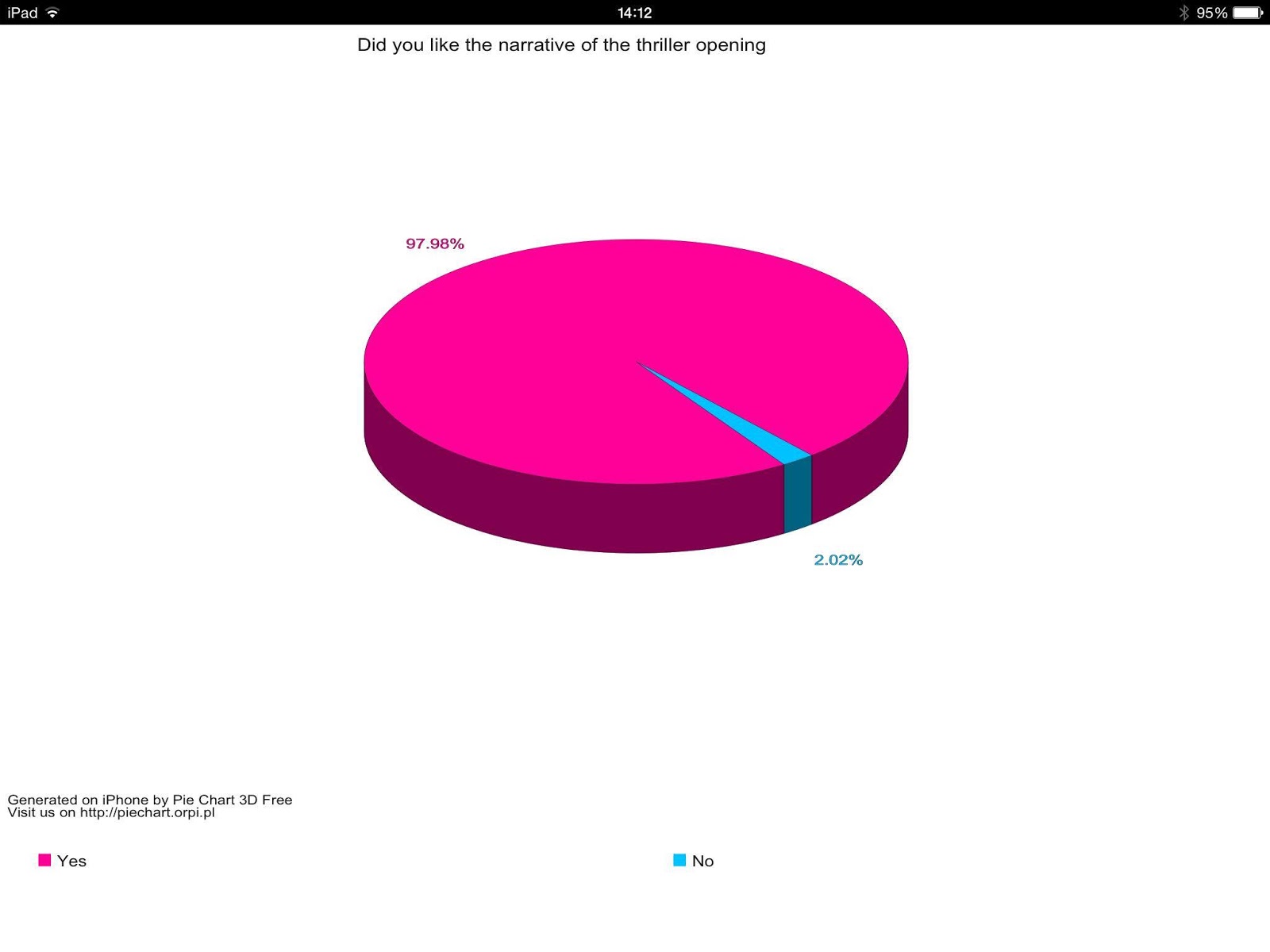
Narrative: This pie chart is displaying the question answered by girls and boys, aged in our target audience, after I asked "Did you like the narrative of the thriller opening". Out of the 20 people I asked, 97.98% of people said yes, whereas 2.02% of them said no. I believe our narrative appealed to this age group because it creates enigma, therefore keeping their close attention but it also has a shocking scene at the end of the opening. 


Technical Codes: Henry liked the editing of the moving image effect we added onto the whole of the woods scene as he felt it looked distorted and he said it gave the impression that someone was watching the main character, which was great feedback as that was our aim. He also said the use of the black and white effect in the hall scene represented her fear and feelings of being afraid, making sense with the plot of the thriller. But a negative part of editing was the pace of the beginning and middle of the opening which he felt was very slow, but liked it when the pace increased at lot at the end, therefore we cut some middle shots down to avoid boring viewers. 

We showed the opening draft to this audience member before adding the voice over and with a different soundtrack to our final one. We changed the soundtrack because he felt it was very calm, mellow and towards the end was still slow, therefore distracted from the story line. We also felt that the sound would be an issue, so it was very useful he confirmed our fears and we were then happy to change it for something that would fit better for the thriller genre. 

Character: He thought the character's feelings and expressions were told through the black and white effect throughout the hall scene. Female's aged in our target audience might be more understanding of this story line as it deals with stalker issues, which many girls are a victim of nowadays, whether its online or actually in person, whereas less male's are victims of this as girls are stereo typically seen as more vulnerable and easier targets. However some male's are also victim's, therefore our character can relate to them and the audience will be interested to see how they handled, dressed the difficult situation. 

Themes: This opening doesn't give much of an incite to the rest of the film because it isn't clear whether the film will continue on in the present of the past. However it's clear to see that themes of vulnerability, fear, hurt and evil are all going to be included in the whole of the film. The viewer also said he would recommend the film as he can imagine it continuing on to be a good film, which is very positive. 
Audience Feedback 2: Melissa, aged 17
Narrative: She liked the fact that there was two different locations to show the story in and thought each one came across well on camera. 

Technical Codes: She enjoyed the contrast between the black and white to the full colour between the two locations. She also liked the clear image throughout the hall scene against the blurred effect in the woods scene.  She also thought the majority of the opening was set at a very slow pace but it worked well in contrast with the faster, shocking ending. 

After receiving Henry's feedback, we removed the soundtrack and didn't add another one until we'd shown the opening to Melissa and so we asked her how she thought the soundtrack could reflect the ideas presented in the film and she gave us helpful feedback when saying to not "overdo it" and keep it simple. She thought having upbeat music wouldn't work with the story line, therefore a slower, yet still edgy paced soundtrack would be effective. 

Our audience feedback was vital for addressing our target audience as they knew what the audifence would like/dislike. 

Thursday, 24 March 2016

Evaluation:Question 2-Jess Smith

Question 2: How does your media product represent particular social groups? 

Throughout our thriller opening we did represent different gender's, age and regional identity. However nothing shown in the opening could lead viewers to make assumptions about ethnicity, sexuality, disability/ability or class and status. All factors are represented through camera use, editing, mise-en-scene and sound.

Gender:  
During the hall scene, Eliza is wearing glitter eyeshadow makeup, which is highlighted by the lighting, which is only worn by females (figures 1&2), therefore it's clear from the begining that the protagonists is a female, especially as she's positioned in the centre of the frame at all times. There are many ECU and CU on her face and eyes throughout the opening.
Figure 1
Figure 2


She is also wearing a femine, white dress, positioned in the cenre of the frame, attracting viewers attention (figures 3&4).
Figure 3
Figure 4

Figure 6
The woods scene also displays her gender as she's wearing a female, cross over black coat and girls shirt (figure 5).
Figure 5


She is also wearing a lot of liquid eye-liner (figure 6), which is usally worn by females. 

I also curled the characters hair before filming the hall scene, whereas she had straight hair for the woods scene, creating a clear difference between settings. This is easy to do for females, whereas male's wouldn't have two different hairstyles. 

It is also clear that the antagonist (stalker is male) becasue of the male shoes and black baggy trousers worn (figure 6). The antagonists hand is also shown at the end when it catches Eliza and he has clear nails, which conforms to him being male as if it was a female they would probably have painted nails (figure 7).


Figure 6
Figure 7

Regional Identity:Our opening also gave a bit of an incite into the regional identity of the character becasue the the cloudy, white sky (figure 1) in the wooded, country side area suggests it's in the UK, but it doesn't get anymore developed than that. 

Figure 1
There is also a medium shot of the antagonists feet in the cruncky, wintery leaves (figure 2), something that happens in cold temperatures.


Figure 2

Age: We chose to use a female character for our protagonists becasue one of our group members friend was happy to be the role, by it is stereotypical to use a female victim and a male antagonists, but it wasn't delibirate. Therefore we went for a more traditional, less modern style. But it works well becasue the protagonists icould be seen as at a vulderable age for females (16), so we wanted to represent her in this way, with headphones in so shes cut off from the world and she thinks she is alone throughout the whole opening.  This all conformed to the thriller genre.

Our soundtrack used apeals to our target audience (taken from our audience feedback) which is around 12-18 year olds as it fits what that age group enjoy when watching thrillers as it's a range of tempo's. The vocieover is done by someone aged 17, therefore in our target audiecne range, which will make it easier for viewers to relate to it, along with the 16 year old actors too. 


Evaluation: Question 6-Jess Smith

Question 6: What have you learnt about technologies from the process of constructing this product?

(One of my cats jumped up infront of the camera at 2:30, sorry)

Wednesday, 23 March 2016

Evaluation:Question 1-Jess Smith

Question 1: In what ways does your media product use, develop or challenge forms and conventions of real media productions?

Thriller films have typical conventions, just like any other genre of film. This ranges from the films always creating enigma, being restricted and unrestricted  narration, iconography through use of camera, editing, mise-en-scene and sound. 


Convention 1: Enigma
Enigma is something every thriller film will want to incorporate into their movie because it makes the qudiecne question the film and will keep their full attention and engagement.
'Face Off' which was released in 1997 by John Woo immediately shows enigma in the opening sequence because it shows a man and a young child looking very happy and content on a merry-go round (figure 1) but then shows a man pointing a gun at them (figure 2). 

Figure 1


Figure 2
My film also creates enigma as there is a voice over which quotes things about being afraid, scared and makes the audience question if this opening actually has anything to do with fear, as nothing happens until the end and they are only shown one character until the end 3 seconds. The opening also creates enigma through the hall scene because it's unclear if this is the present day, in the past or in the future at the beginning. 

Convention 2: Shallow Depth Of Field
This camera shot is often used in thriller films because it draws the audience's attention in towards a specific object or person. The thriller 'The disappearance of Alice Creed' (in 2010 by J Blakeson) display this convention as one of the characters picks up objects in a shop.(figure 1&2). 
Figure 1


Figure 2

My opening for a thriller also used shallow depth field shots, to conform to the typical thriller conventions. The camera shot worked really well during our woods scene as it showed the detail of the tree trunk that the stalker was behind, with the character walking past, positioned to the left of the frame (figure 3).
Figure 3


Figure 4

 We also used shallow depth of field when showing a leaf blowing in a soft wind (figure 4). 


Convention 3: Extreme Close Up Shot (ECU)
Thrillers like to include many extreme close up shots throughout their films because they focus at a much closer angle, in comparison to any other shot type. Because of this the camera receives a high amount of detail onto the person/object that is in the frame, making the audience feel as though their that close to the person/object too, keeping their attention.
Figure 1

The thriller film 'Inception' (released in 2010 by Christopher Nolan) and starring Leonardo DiCaprio uses an extreme close up shot within the first 30 seconds of the film starting (figure 1). This image reflects the purpose of this shot type because it's presents the desperation his face to the audience who have just began watching, ensuring they continue watching to find out why he's appeared in this state.

Inception's opening also used another ECU (figure 2) of a gun on a wooden desk. This was done to shock viewers and to keep their attention as they predict who's it is, what will they do with it etc...
Figure 2


Similarly, I used many extreme close up shots in my thriller opening because I wanted to convey the sense of loneliness and fear that the Eliza felt standing in the hall. I had an ECU on her right eye closing (gif 1).


Gif 1
We felt this conveyed emotion and sadness, as well as another ECU we did on both of her eyes abruptly closing a few seconds later (gif 2). We then made a quick cut from this ECU to titling, which created a shocking affect. 
Gif 2


In addition, we also used an ECU on her lips as she heavily breathed in and out (gif 3). This emphasized the intensity of the scene.
Gif 3
We then had another ECU on her upper chest and collar bones during her heavy breathing (gif 4). This shot really portrayed the thriller genre in my opinion as her breathing could have stopped any minute.
Gif 4


We used a pan on another ECU twice. We used the same shot style in the woods scene (gif 5), as well as the hall scene (gif 6). 
Gif 5


Gif 6
The camera was positioned in an ECU shot type as it panned down her right hand arm down to her hand as it tightly clenched, in both scenes. We did this because it showed continuity and I thought it would be unique to do the same shot type in both of the two locations.

Lastly, we used another ECU at the end of the opening when the stalker place his hand on Eliza's shoulder (figure 7).
Figure 7

By applying the camera in this position it allowed viewers to feel the intensity that we tried to portray and also allowed them to see the shock and fear in Eliza's face.

Convention 4: Unrestricted and Restricted Narration (Sound)
Narration is commonly in used in thriller films because it usually gives the audience an incite to the narrative of the film, however in some thriller films the narration can confuse the audience, but this will be done on purpose to create that enigma. 

The 2003 film 'Adaptation' by Spike Jonzes uses narration from 18 seconds into the thriller until 1:54 seconds and it is highly effective because the male voice is speaking about himself, which allows viewers to make the assumption that he is the main character, therefore already there is an incite to the narrative. 

Our film has a narration from 14 seconds into the opening up until the ending of the opening, but with gaps in between. We wanted to do a narration because it meant our opening would definitely fit in the thriller genre and would add to the enigma of it as the narration only gave a very narrow incite to the film. 

The non diegetic soundtrack in thrillers can communicate a lot if they mix well with the moving image, for example 'Face Off' (1997 by John Woo) chose as very effective soundtrack when the father and son are on the merry-go round as it's a very soft, light and joyful sound, matching the happy scene, however when the villain is shown the soundtrack changes to a very violent banging sound and they made a great transition from one to the other. Therefore we also wanted to do this and incorporate the feelings of the scene into the soundtrack, so we used a softer sound to begin with and it gradually built up, parallel to the moving image.  

Convention 5-Titling
Titling organisation was important for our thriller. We knew we wanted it to be quite plain and simple, especially because independent research in thriller genre films titling conformed to this idea. The title of our thriller reflected the titling used in "Face Off" (by John Woo) and "Psycho" (1960 by Alfred Hitchcock) because they used white, simple text on a black background. We thought this worked very effectively because it was clear for the audience to the information but is still dark and secretive, like our thriller. For our ending title (figure 1) we adjusted to font size to a larger size because we wanted it to be shocking and to fill the frame, similar to "Hannah" (2011 by Joe Wright) in figure 2. We added titling in throughout the beginning, middle and end of the thriller because it looked professional and sophisticated, similarly to other thrillers such as "Rear Window" and "The Dark Knight". We put our logo and production company at the beginning (figure 3) as most other thrillers to this, such as "Face Off" and "Rear Window (figure 4).
Figure 1
Our thriller titling
"Face Off" titling


"Psycho" Titling


Figure 2


Figure 4


Figure 1


Figure 5


As a group, we wanted our 
Figure 2
opening to incorporate iconography for thriller of the thriller genre, therefore we used low key lighting in half of the opening (hall scene). We didn't want any lights on in the room, apart from our one spotlight and we filmed the majority of the scene when it was completely dark outside, therefore no sunlight was coming through the large window. But for the woods scene we filmed in the natural daylight to create a contrast with the two settings. Having the woods brightly lit also juxtaposes the fact that during that time is when she is being followed, but in the minimal hall lighting nothing else is there with her. The thriller 'Phone Booth' (2003 by Joel Schmacher) uses natural daylight too (figure 1) and 'Kill Bill' (2003 by Quentin Tarantino) uses low key lighting (figure 2). 

We wanted creative through the camera by including a wide range of shots and pan's, tilts and tracking, especially as all thrillers do this. We used a pan 3 times, but we used the same idea for 2 of them and did one pan slowly (gif 1) and the other at a quick pace (gif 2), to create variation and continuity. 
Gif 1


Gif 2


We didn't use of the typical props, such as gun's, knifes or any other harmful weapons, which some thriller films include, such as 'Inception', 'Face Off' and 'The Disappearance of Alice Creed' included because it wasn't necessary for our story line, similarly to 'Silence of the Lambs' who also don't include them. Similarly, no fake blood was needed either.

Filming in the woods was stereotypical for the thriller films, but we used this setting because we believed it would help convey the genre. Thriller 'Silence Of The Lambs' also used the woods in their film (figure 3). We had a male for our antagonist and a female as the protagonist which is also stereotypical, similarly to 'The Disappearance of Alice Creed'. 
Figure 3

We edited the whole of the hall scene into a black and white filter during post production and this was inspired by 'Kill Bill' as the film is all in black and white (figure 4) and it looked very effective and gave that sense of innocence, more than colour does, therefore we like it for the hall scene footage. 

Figure 4

Thriller films apply to Todorov's theory with 3 main stages:
1. Equilibrium-The beginning of the story and protagonist is calm and secure 
2.Disruption-action that caused the story line to change
3. New Equilibrium-the problem has been fixed


The disappearance of Alice Creed conforms to Todorov's theory as the story begins with Alice in a committed relationship with Danny but then he takes her hostage for 'her own good' and threatens her with a gun. But it ends with Danny dying and Alice escaping (the new equilibrium).


But our thriller doesn't conform to Todorovs theory as it doesn't start with an equilibrium or end with a new equilibrium but it does use the typical theme of a stalker which is a realistic issue some people experience.